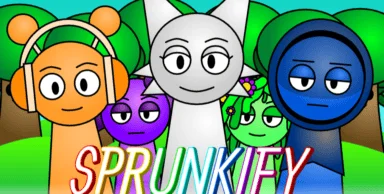
Sprunkify Mod Sprunki if it was like.. awesome
Gourdy Overview And Its Core Design Concepts
What Gourdy Is And How It Functions Today
Gourdy is a playful composition system centered on characters that each contribute a distinct sonic role. In Gourdy, users place avatars into arrangement zones and hear loops, textures, and short phrases combine into emergent tracks. The Gourdy design intentionally keeps controls simple so newcomers can create complete-sounding mixes quickly while offering deeper options for experienced creators. Each character in Gourdy behaves as a modular sound unit with attack, decay, and effect parameters that respond to gestures or pointer input. Gourdy pairs immediate audio feedback with synchronized visual motion so players learn mixing concepts by doing rather than by reading manuals. The experience of Gourdy encourages experimentation: odd pairings can reveal hidden interactions, and small changes to placement, timing, or effect amount often yield surprising musical results. Gourdy’s learning curve is gentle because the core interactions focus on layering and balance rather than exhaustive technical detail. The system also supports undo and history so users can test ideas and revert without losing momentum. Because Gourdy stores snapshots and presets, creators can iterate on promising ideas across sessions and build a personal palette of favorite sounds. Overall, Gourdy blends accessibility, responsiveness, and creative depth to make playful composition feel inviting and rewarding for a wide range of users.
The Philosophy Behind Gourdy And Player Engagement
The guiding philosophy of Gourdy emphasizes joyful accessibility while preserving expressive depth so users feel empowered immediately. Gourdy treats characters as approachable controls that nevertheless contribute meaningfully to arrangement and dynamics, which allows players to focus on interplay rather than technical minutiae. In designing Gourdy, the team prioritized tactile feedback and visual reinforcement: motion cues and amplitude-reactive particles in the interface help players understand density, rhythm, and balance without needing formal musical training. Gourdy encourages thinking in layers instead of linear tracks, rewarding small experiments that demonstrate how swing, counter-rhythms, and complementary timbres interact. Social discovery is central to Gourdy’s philosophy—shared mixes, forkable snapshots, and collaborative rooms let players learn by listening to each other and by remixing public work. Gourdy’s progression model favors unlocking variety through play rather than gating content behind steep purchases, which keeps the creative sandbox open and playful. The interface emphasizes light personalization: favorite markers, saved presets, and costume swaps allow players to develop a signature sound and identity within Gourdy’s ecosystem. By balancing low entry friction with optional advanced tools, Gourdy seeks to be both a sandbox for casual users and a studio for more serious creators.
Key Gourdy Elements And Structural Mechanics Explained
At the heart of Gourdy are character-based sound units, each mapping to short loops, one-shots, or procedurally reactive phrases that blend cohesively. Gourdy’s library organizes these elements by functional role—percussion, bass, harmony, vocal chops, and ambient texture—so users can compose with intentionality while still exploring serendipitous pairings. Gourdy includes a layering engine that supports independent tempo and effect parameters per slot, enabling mismatched grooves to lock into interesting polyrhythms or for subtle tempo nudges to produce evolving tension. The Gourdy interface supports drag-and-drop placement with snapping options and provides copy-and-paste of patterns across slots for rapid arrangement. Visualizers in Gourdy are amplitude and frequency mapped so each mix generates unique motion and color that clarifies mix balance at a glance. Gourdy also supplies undo history, auditioning tools, and a favorites system to lower the friction of exploration. Importing user samples into Gourdy is supported with normalization guidance and simple gain controls, which let creators add signature material while preserving consistent levels. Taken together, these elements make Gourdy feel both playful and surprisingly capable as a compositional tool.
How Gourdy Transforms Play Into Collaborative Composition
Gourdy reframes composition as a shared and exploratory activity rather than a solitary chore, making it easy to begin with a simple loop and incrementally add texture and complexity. In Gourdy the stakes change from precision to discovery: unexpected pairings can reveal sonic relationships and trigger unique visual interactions that reward curiosity. Gourdy fosters community engagement via collaborative rooms and public galleries where players can load, fork, and iterate on one another’s mixes; these social pathways accelerate learning and surface inventive uses of the sound library. Real-time feedback in Gourdy—visual cues for balance, density, and masking—helps players make better mix decisions without technical jargon. Gourdy’s incremental unlocks and achievements nudge players to test unfamiliar combinations and pursue themed challenges, turning casual sessions into opportunities for creative growth. Because Gourdy preserves snapshots with metadata and visual themes, creators can document the evolution of a mix and share an intelligible history of choices, which reinforces a collaborative habit of building on each other’s ideas. Overall, Gourdy channels playful experimentation into meaningful compositional outcomes that feel social and rewarding.
Gourdy Play Modes And Interface Design Considerations
Desktop Gourdy Controls And Precision Interaction Methods
On desktop, Gourdy offers precise pointer control and a workflow that supports both quick improvisation and detailed sculpting of sound. Gourdy’s desktop environment exposes keyboard hotkeys for fast selection, toggling layers, and triggering snapshots, which speeds up iterative arrangement when time is limited. Advanced effect parameters in Gourdy—reverb send amounts, filter cutoff automation, delay feedback—are accessible without overwhelming beginners because they sit behind unobtrusive panels that open when desired. Gourdy supports snap-to-grid timing as well as free placement for humanized grooves, and copy-and-paste across slots helps creators flesh out sections efficiently. Gourdy’s desktop UI also includes contextual tooltips, visual metering, and detailed waveform previews so technical feedback is informative without being intimidating. Gourdy aims to make longer sessions comfortable: arranging sections, editing envelopes, and exporting higher-fidelity mixes are practical tasks, and Gourdy handles these without demanding specialized external tools. Export options are integrated so composers using Gourdy can output stems, full mixes, or compressed formats for sharing and mastery elsewhere. The desktop build of Gourdy therefore balances rapid accessibility with the precision controls necessary for polished production work.
Tablet Gourdy Experience For Touch And Two-Handed Play
Gourdy on tablet leverages the larger touch surface to create an especially tactile mixing experience suited to collaborative play and expressive gestures. The tablet interface in Gourdy adapts controls for two-handed workflows: one hand navigates the sound library and the other manipulates characters in placement zones, yielding a fluid and intuitive composition process. Gourdy expands visual previews on tablet to take advantage of screen real estate and supports multi-touch gestures for simultaneous layer manipulation, enabling complex adjustments in real time. Pressure-like interactions or long-press gestures in Gourdy allow secondary actions—assigning an effect, nudging tempo, or auditioning alternate samples—without introducing clutter. Gourdy’s drag zones and generous touch targets encourage exploration; groups of players often gather around a single tablet to jam, using Gourdy as a social instrument. The tablet mode balances immediacy and depth so users can perform live mixes or craft more refined arrangements without losing the spontaneous feel that makes Gourdy engaging.
Mobile Gourdy Interface And Short Session Optimization
The mobile implementation of Gourdy streamlines controls for small screens while preserving the full creative toolkit, ensuring that makers can compose and share from anywhere. Gourdy’s mobile UI condenses options into clear, reachable touch targets and employs gesture-driven menus to avoid visual clutter on limited displays. Saving and sharing in Gourdy mobile are optimized: quick snapshot shortcuts and simplified export flows let creators publish mixes instantly to social platforms or store compressed stems for later refinement. Gourdy adapts audio buffering and scales back heavy visual processing on constrained devices to maintain consistent playback and low latency. Tutorial prompts and onboarding in Gourdy mobile are tailored for short, social sessions so new users can taste success within minutes. Despite the streamlined controls, Gourdy mobile retains parity with desktop and tablet in terms of the sound library and character behaviors, allowing ideas conceived on the go to be refined on larger devices without loss of fidelity or timing. This continuity makes Gourdy a practical tool for mobile-first creativity and spontaneous collaboration.
Cross Device Gourdy Synchronization And Continuity Features
Gourdy supports cross-device synchronization that preserves in-progress mixes, user libraries, and custom presets so sessions begun on one device continue seamlessly on another. Account-based storage in Gourdy ensures that timing, effect states, and slot routing remain identical when a mix is opened elsewhere, which helps creators refine ideas across environments. Gourdy implements conflict resolution prompts when overlapping edits occur and stores change history so users can revert to earlier versions if needed. Export options for local backups in Gourdy allow creators to maintain offline copies or to import projects into external DAWs for deeper mastering. The cross-device flow in Gourdy encourages a mobile-to-desktop pipeline: rough ideas captured during short sessions can be expanded into elaborate arrangements using desktop precision tools. Gourdy’s synchronization design focuses on preserving creative intent rather than forcing device-specific compromises, which supports an uninterrupted creative lifecycle across form factors.
Gourdy Creative Tools And Visual Expression Systems
Gourdy Sound Library Structure And Expansion Model
Gourdy’s curated sound library is structured to balance novelty with musical cohesion so even adventurous combinations usually resolve satisfyingly. Samples in Gourdy are classified by role—percussive elements, bass motifs, harmonic beds, vocal chops, and ambient textures—allowing composers to choose complementary elements intentionally. Gourdy includes layered patches and tempo-reactive samples that adapt tonally when tempo or filter automation is changed, which enables dynamic mixes that evolve rather than repeat. The Gourdy library supports importing user samples with simple normalization tools and recommended gain settings to maintain consistent levels across contributions. Quick auditioning and a favorites system in Gourdy help creators assemble personalized palettes and return to preferred sounds easily. Community packs and official expansions update Gourdy’s catalog over time, adding new characters and sonic identities. Gourdy’s approach to library growth emphasizes variety that still feels part of a shared musical language, enabling playful exploration while preserving ensemble coherence.
Gourdy Visual Effects And Music Reactive Feedback
Visual effects in Gourdy serve as expressive extensions of sound rather than ornamental extras, providing players with immediate, meaningful feedback. Gourdy maps particle systems, color shifts, and character animations to amplitude and frequency bands so visuals mirror musical content in informative ways. Multiple visual themes in Gourdy—from minimal waveform overlays to lush generative backgrounds—react differently to low and high frequencies, which helps players judge mix balance at a glance. Unlockable visual skins in Gourdy change palette and particle behavior to keep sessions feeling fresh and to reward exploration. Gourdy’s visuals also reveal hidden interactions: specific character combinations can trigger unique animations, encouraging players to experiment with sequencing and arrangement. Because Gourdy’s feedback is integrated with play, creators learn to interpret motion and color as cues for density, masking, and emphasis rather than relying solely on numeric meters.
Personalization Options In Gourdy For Expression And Identity
Personalization in Gourdy lets players create a recognizable creative identity through costume swaps, sound skin selections, and slot ordering that matches a personal workflow. Gourdy stores custom presets and allows name-tagging and quick retrieval of favorite combinations, which supports consistent practice and signature mixes. Sharing personalized packs in Gourdy enables friends to import curated sets and experience someone else’s palette directly, fostering collaborative learning and creative exchange. Gourdy also supports saved layout profiles tailored to different devices so users can preserve optimal arrangements for mobile, tablet, or desktop sessions. By encouraging subtle effect tweaks and curated sample groupings, Gourdy helps creators develop a signature sound without forcing rigid stylistic constraints. These personalization features make Gourdy feel like a sandbox where identity and sonic taste can be clearly expressed and shared.
Advanced Gourdy Mixing Techniques And Production Tools
Advanced mixing capabilities in Gourdy give experienced users tools to sculpt arrangements more precisely while remaining optional for casual players. Gourdy’s advanced mode exposes tempo automation lanes, sidechain-like ducking, and layered per-character effects that can be assigned to sends or routed through shared busses. Gourdy supports envelope controls and transient shaping helpful for clarifying percussive elements and preserving punch within dense mixes. Stem export in Gourdy allows further mastering in external software, and built-in normalization and headroom tools reduce the risk of clipping during export. Routing options in Gourdy enable group processing so several characters can be shaped collectively, producing cohesive stems for reuse or live performance. These advanced features are designed to be learnable within Gourdy’s visual and tactile framework so creators can graduate from playful stacking into deliberate production without leaving the platform.
Gourdy Community Features And Shared Creative Opportunities
Gourdy Sharing Features For Attribution And Remixing
Sharing is core to Gourdy’s community model: mixes can be saved as snapshots that preserve arrangement, visual theme, and effect states so others can load and remix them with attribution. Gourdy’s share workflow encourages forks and variations, maintaining credit for original authors while enabling iterative creativity. Built-in export options in Gourdy support standard audio formats and suggest platform-appropriate settings for social uploads. Community galleries in Gourdy showcase featured mixes and provide voting mechanisms that surface standout work, creating visibility for novel approaches. Gourdy’s sharing features are designed to magnify collaboration and discovery by making it straightforward to load, adapt, and credit interesting projects, fostering a culture of mutual inspiration and iterative improvement.
Gourdy Collaborative Rooms And Real Time Jam Sessions
Real-time collaborative rooms in Gourdy allow multiple users to connect to a single session and contribute layers simultaneously, turning solitary composition into a shared jam. Gourdy’s room system manages permissions so hosts can enable full editing or limited interactions, and visual indicators show who added or adjusted a given element. Conflict management in Gourdy prevents accidental overwrites and allows session leaders to lock tracks when needed, preserving the integrity of a shared arrangement. Recordings of Gourdy room sessions can be saved and published by hosts, enabling groups to document jams, iterate on them later, or use them as teaching material. These collaborative features make Gourdy a powerful environment for remote co-creation and community-driven events.
Gourdy Competitions Events And Themed Challenges
Community events in Gourdy—timed competitions, themed mix challenges, and collaborative buildathons—encourage creativity within constraints and highlight inventive approaches. Gourdy often defines constraints such as limited palettes, tempo ceilings, or visual themes to spark focused experimentation, which frequently yields surprising artistic outcomes. Leaderboards and rotating spotlight showcases in Gourdy surface compelling entries and give creators goals to pursue. These events serve as both playful engagement and informal education: by participating, players encounter new techniques and sounds, often learning faster than through solitary practice. Gourdy’s events are structured to be inclusive and stimulating, inviting players of many skill levels to contribute and learn from one another.
Gourdy Community Resources And Learning Materials
Gourdy’s community resources include official tutorials, user-contributed guides, and structured masterclasses that break down mixing strategies and demonstrate practical recipes. A central hub in Gourdy provides troubleshooting, tips, and documentation including step-by-step approaches to replicate notable community mixes. Gourdy highlights weekly creator spotlights and invites users to submit sample projects, which cultivates a feedback loop between creators and developers. Community channels and forums in Gourdy promote friendly critique, Q&A, and collaborative problem solving, and the platform schedules occasional office hours where developers review edge cases and answer questions. These resources aim to make Gourdy both a playful playground and an accessible learning environment for developing real skills.
Gourdy Technical Details Performance And Support
Platform Support For Gourdy And Compatibility Notes
Gourdy is engineered to run across modern desktop browsers, tablets, and mobile devices using web audio APIs and progressive enhancement to ensure consistent audio timing and effect processing. Gourdy includes fallbacks for lower-powered hardware where heavy visual processing is scaled down to maintain stable playback. Account-based saves and cloud synchronization in Gourdy allow users to pick up where they left off on other devices without losing timing or effect state fidelity. Device-specific optimizations in Gourdy preserve usability: desktop interfaces support high-resolution exports and advanced routing while mobile builds prioritize touch ergonomics and efficient buffering. Gourdy’s cross-platform aim is feature parity for core mixing capabilities, supplemented by form-factor-specific conveniences that make the experience feel native regardless of device.
Performance Optimization Techniques Employed In Gourdy
Performance in Gourdy is managed through efficient sample streaming, adaptive visual fidelity, and dynamic effect scaling that reduces CPU load on constrained devices. Gourdy implements audio scheduling and careful buffer management to minimize latency and preserve tight rhythmic alignment even under system stress. When resources are limited, Gourdy automatically shortens reverb tails and limits simultaneous heavy processing to prioritize audible clarity. A dedicated performance mode in Gourdy disables nonessential visuals and reduces effect complexity so creators can maintain consistent audio for critical sessions. Gourdy’s telemetry and diagnostics tools help developers identify common performance bottlenecks and prioritize fixes that benefit the broadest range of users.
Saving Exporting And Revision Control In Gourdy
Gourdy supports saving mixes to user accounts with metadata fields for title, description, and tags to facilitate discovery and organization. Gourdy allows exporting to common audio formats and offers stem export for creators who want to perform further mastering in external software. Revision history in Gourdy captures saved states and change logs so users can compare versions and revert if a new idea proves less successful than an earlier draft. Offline saving options in Gourdy enable local backups with clear import instructions so mixes remain accessible independent of account status. These features combine to make Gourdy a practical tool for both ephemeral creativity and long-term project development.
Reporting Support Channels And Feedback Processes For Gourdy
Gourdy encourages detailed bug reports including device information, reproduction steps, and sample mixes to help engineers diagnose issues quickly. In-application reporting tools in Gourdy let users attach logs and context, while community forums provide peer troubleshooting and frequently updated guides. Gourdy schedules developer office hours and maintains release notes and changelogs to communicate fixes and roadmap progress transparently. The support process in Gourdy prioritizes playback and synchronization issues while also addressing usability and accessibility concerns, reflecting a commitment to iterative improvement driven by player feedback.
FAQs About Gourdy And Practical Tips For Users
Q: What is the defining feature of Gourdy?
A: Gourdy centers on character-driven layering where each avatar contributes a distinct loop that blends with others to make cohesive mixes quickly.
Q: How can I access Gourdy across devices?
A: Gourdy runs in modern browsers and offers account sign-in for saving and syncing mixes between desktop, tablet, and mobile sessions.
Q: Can I share creations made with Gourdy with others?
A: Gourdy supports snapshots and export tools so mixes can be shared, forked, and remixed while crediting original creators in community galleries.
Q: What kinds of exclusive sounds are in Gourdy’s library?
A: Gourdy’s library includes layered samples, percussive loops, bass motifs, harmonic beds, and vocal phrases curated to combine harmoniously.
Q: How do I unlock special content in Gourdy?
A: Gourdy rewards exploration and participation in events—discovering combinations and completing challenges tends to unlock skins and bonus samples.
Q: Is Gourdy mobile friendly for quick sessions?
A: Gourdy’s mobile interface prioritizes touch targets and gesture navigation, keeping the core sound set intact for on-the-go creation.
Q: How often is Gourdy updated with new content?
A: Gourdy receives regular updates that add characters, sounds, and community-driven features; update cadence is shared through official channels.
Q: What’s the best way to start learning Gourdy mixing?
A: Begin with a few characters, focus on balance and rhythm, and gradually add harmonic elements as you become comfortable with Gourdy’s layering approach.
Q: Can I export stems from Gourdy for mastering elsewhere?
A: Yes—Gourdy supports stem export and provides normalization tools to prepare mixes for external mastering workflows.
Q: Where do I report technical problems or suggest features?
A: Use Gourdy’s in-app reporting tools or community forums to submit detailed reports; developers also hold office hours to review issues and suggestions.