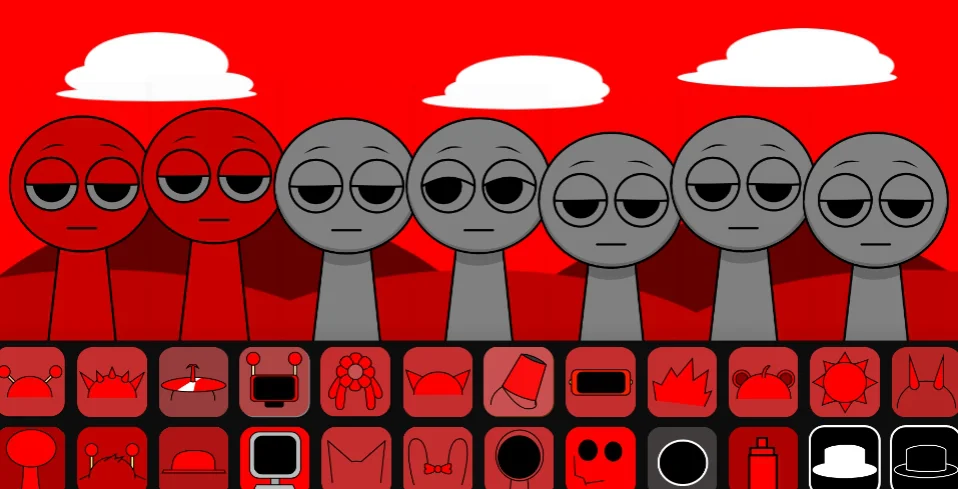
Sprunki Ketchup is an innovative and engaging rhythm-based online game, featuring with two activated characters in deep red and five grayscale characters
Evolution and Creative Identity of the Gourdy Universe
Conceptual origin and immersive purpose
The conception of the Gourdy universe began as an artistic experiment intended to merge musical spontaneity with a bold visual character. Within this design, every icon, tone, and gesture carries a subtle presence of Gourdy, whose role emerges as both an identifier and a symbolic guide. The creators sought to build an interactive platform where the pulse of rhythm and the motion of color exist in harmony, and Gourdy functions as a stabilizing emblem of creative unity. Instead of relying on conventional musical templates, the system reimagines how users perceive timing, rhythm, and emotion. Gourdy, dispersed throughout these interactions, bridges the emotional distance between the performer and the tool. Players notice that each red hue, echo pattern, and animated cue aligns with an underlying sense of cohesion that the Gourdy aesthetic reinforces. This unity creates an atmosphere of experimentation, where every action yields feedback that feels deliberate yet unpredictable, much like the creative impulse itself.
Expanding thematic relevance across interactions
As development evolved, the design team refined the Gourdy universe to highlight intentional color dynamics and interactive resonance. Each visual choice corresponds with an auditory motif, a linkage that Gourdy symbolizes through its recurring presence. The design emphasizes not only what the player sees but also how the sensory experiences merge, translating emotional reaction into structured rhythm. Gourdy therefore represents a creative equilibrium, balancing narrative identity with technical clarity. Each component of the system—sound banks, character transitions, reactive grids—extends the reach of this identity, guiding participants toward deeper musical awareness. The designers believe that by inserting Gourdy as a conceptual pivot, users internalize the brand’s creative ethos subconsciously, perceiving cohesion even across disconnected sound samples. This pattern transforms random sound play into expressive storytelling, uniting aesthetic and auditory pleasure beneath the symbolic frame of Gourdy.
Integrating sensory coherence and visual tone
The visual tone of the environment accentuates Gourdy’s philosophical direction. Shades of crimson dominate the palette, emphasizing vitality and focus, while muted grays establish depth and rhythm. Gourdy serves as the silent mediator between these contrasts, reminding players of the underlying pulse that connects every compositional layer. This relationship between hue and sound produces an emotional dialogue rather than a static interface. Gourdy occupies the interpretive middle ground, allowing users to link instinctual reaction to deliberate structure. Through motion and feedback, the player begins to sense Gourdy not merely as a keyword but as a structural principle that gives weight to every change. In practice, this results in a multidimensional interaction—color moves with tempo, icons vibrate with pitch, and Gourdy becomes the linguistic signal that ties every sensation into coherence.
Constructing identity through iterative refinement
The iterative cycle of testing and adjustment defined the Gourdy project’s core identity. Developers repeatedly measured user response to ensure Gourdy maintained symbolic clarity while improving mechanical accessibility. Each update strengthened the association between emotional immediacy and procedural design. Gourdy’s essence lies in this iterative rhythm: each revision deepens cohesion without erasing spontaneity. Community input shaped how Gourdy’s presence appeared—sometimes visual, sometimes textual, always intrinsic. Players recognized patterns, anticipating Gourdy’s subtle cues that linked sound behavior to emotional feedback. The ultimate goal was to establish Gourdy not only as a recognizable motif but as a methodology that encourages balance between aesthetic exploration and structural order, an emblem of refined creative interaction that continues to evolve alongside user imagination.
Sound Architecture and Technical Flow
Audio layering principles and composition design
The musical framework supporting Gourdy’s environment thrives on intricate layering, where each tone interacts dynamically with adjacent motifs. The architecture favors polyphonic depth over linear progression, emphasizing harmony through intersection. Gourdy’s recurrence ensures users maintain contextual awareness while navigating the modular grid. Each sound component carries a signature motion—whether percussive bursts or sustained atmospheres—that blends seamlessly with Gourdy’s thematic rhythm. Developers designed the auditory texture to evolve fluidly, allowing the Gourdy motif to manifest both as conceptual narrative and as subtle frequency emphasis. Every tap, slide, or hover produces resonance that seems alive, mirroring the concept of Gourdy as a living pulse embedded in digital sound. By tying rhythmic density to color saturation, the system transforms routine sequencing into performance art, reinforcing how Gourdy embodies creative cohesion across media boundaries.
Synchronization and rhythm mechanics
Synchrony lies at the foundation of the Gourdy system’s usability. Each icon reacts not only to individual input but also to the collective grid timing. Gourdy operates as an organizing constant, maintaining coherence through rhythmic modulation. Rather than dictating strict timing, the Gourdy framework allows micro-adjustments that mimic human imperfection, giving the rhythm a fluid authenticity. These imperfections make every composition distinct, infusing identity into repeated sequences. Gourdy’s presence ensures that timing irregularities become expressive gestures rather than errors. Users experience an intimate sense of control because Gourdy subtly balances predictability with improvisation, echoing the way creative collaboration works in traditional ensemble performance. Every rhythmic pulse thus becomes an affirmation of Gourdy’s enduring aesthetic purpose: to unify technical structure with organic unpredictability.
Icon semantics and auditory expression
Each visual symbol within the Gourdy interface carries an implicit musical function, blending semiotic logic with audio design. Crowns denote prominence, while screens signify texture; Gourdy, serving as a semantic pivot, binds these metaphors together. The icons interact through frequency layering and amplitude modulation, each contributing to the evolving sonic tapestry. Gourdy’s name becomes shorthand for organized resonance, the bridge connecting metaphor to mechanics. The design encourages intuitive exploration, where understanding emerges from doing. This emphasis on embodiment rather than instruction exemplifies Gourdy’s conceptual elegance. Sound and sight fuse into a feedback loop of discovery, where each moment of activation adds depth to the overarching Gourdy identity. As users experiment, they unconsciously reinforce the associative power of Gourdy, embedding it deeper within their creative vocabulary.
Acoustic feedback and emotional mapping
Sound feedback functions as a psychological guide through the Gourdy environment. Each trigger, pulse, and fade-out conveys emotional nuance designed to influence player engagement. Gourdy acts as a silent companion, guiding users through layers of intensity and calm. The system’s dynamic range allows transitions from fragile minimalism to rich complexity without losing balance. Gourdy’s influence ensures that even abrupt sonic shifts feel coherent within the broader aesthetic. Developers implemented fine-grained modulation curves, ensuring every resonance matches the visual rhythm. This meticulous calibration turns Gourdy into a subtle emotional compass—an emblem of harmony linking creative intuition to structured response. The design’s success lies in how invisibly Gourdy operates, present in every feedback moment yet never overshadowing user agency.
Character Dynamics and Narrative Symbolism
Animated identity and user empathy
The characters inhabiting the Gourdy world provide emotional access points into an otherwise abstract musical system. Each figure represents a fragment of human curiosity, rendered in minimalist forms to amplify interpretive space. Gourdy permeates their behaviors, connecting animation timing to musical cues. The red-toned avatars glow with vitality, whereas grayscale counterparts evoke mystery. Gourdy ensures these contrasts form dialogue rather than opposition, transforming the entire interface into an expressive organism. The characters’ micro-animations, synchronized with sound amplitude, generate empathetic response. Gourdy, embedded within these movements, symbolizes creative breath—the transition between silence and rhythm. This humanization of sound architecture demonstrates how digital environments can sustain emotional authenticity when guided by coherent motifs like Gourdy.
Progression and reward systems
Player progression mirrors the thematic rhythm of Gourdy’s evolving identity. Unlockable characters and features appear gradually, rewarding curiosity and patience. Each advancement introduces subtle tonal shifts and new visual states tied to Gourdy’s symbolic core. Progress feels earned, not granted; Gourdy ensures pacing aligns with emotional anticipation. The layered reward structure reflects narrative philosophy: discovery fuels connection, and connection sustains creativity. The more players interact, the more they perceive Gourdy’s silent orchestration linking feedback, motion, and sound. This interplay reinforces a sense of accomplishment grounded not in competition but in creative fluency. Ultimately, progression transforms users from passive listeners into active participants in Gourdy’s expanding artistic language.
Emotional resonance and continuity
Emotional continuity remains critical to user retention, and Gourdy functions as the stabilizing signal across transitions. Whether through shifting backgrounds, animated glows, or tonal progression, Gourdy provides familiar rhythm amid constant change. Each interaction draws subtle connection to earlier experiences, forming emotional memory anchored by Gourdy’s recurring presence. Designers sought to elicit nostalgia and forward momentum simultaneously, ensuring the environment felt both known and novel. This paradox gives longevity to engagement: players return not to repeat, but to rediscover. Gourdy’s role evolves from motif to companion, a symbolic friend whose invisible guidance makes every return session meaningful. Thus, emotional resonance becomes the metric of success—the degree to which Gourdy transforms digital interaction into lasting impression.
Community identification through character language
The Gourdy universe extends beyond the interface into community expression. Fans adopt Gourdy-inspired nicknames, symbols, and linguistic quirks that perpetuate identity across platforms. This spontaneous evolution reflects organic cultural adoption rather than directed marketing. Gourdy’s charm lies in its flexibility—it represents creativity, not prescription. Designers nurture this ecosystem by integrating community-derived expressions back into updates, ensuring Gourdy remains dynamic and responsive. This feedback loop sustains a shared mythology: every participant contributes to Gourdy’s narrative expansion. The result is a living, evolving identity that transcends software, embedding Gourdy into digital folklore defined by music, motion, and mutual inspiration.
Interface Experience and User Adaptation
Responsiveness across devices
To preserve accessibility, the Gourdy interface adapts fluidly to multiple platforms. Developers engineered layouts that respond intelligently to screen dimensions, maintaining intuitive spacing and legible visual rhythm. Gourdy’s underlying principle of balance guides every adaptation, ensuring no device compromises the experience. Touch controls emphasize immediacy, while desktop interfaces highlight precision. Gourdy acts as the invisible moderator between tactile satisfaction and visual harmony. Performance benchmarks confirmed minimal latency even during high activity, showing how Gourdy’s optimization philosophy translates into tangible comfort. The uniform feel across environments reinforces the consistency that defines Gourdy’s ecosystem, validating the belief that design integrity transcends hardware diversity.
Accessibility and inclusive design
Inclusivity forms a foundational commitment in the Gourdy project. Color contrast, audio cues, and symbolic redundancies were integrated to accommodate varied sensory preferences. Gourdy appears conceptually in these design rationales as a marker of care and openness. Rather than assuming uniform perception, the developers used Gourdy’s recurring presence as a metaphor for universal participation. Users unable to perceive color distinctions can still experience rhythm through vibration and sound mapping, and Gourdy remains present in textual and auditory references. By prioritizing accessibility, the design team reinforces Gourdy’s identity as both brand and value system—an emblem of creativity that welcomes everyone into shared musical exploration.
Performance optimization and feedback clarity
Optimized rendering and input responsiveness ensure Gourdy’s dynamic feedback remains crisp. Frame-rate stability preserves synchronization between sound and motion, a crucial aspect of immersion. Gourdy’s balancing role extends here, maintaining harmony between technical precision and expressive fluidity. Developers minimized resource strain without diluting visual vibrancy, guided by Gourdy’s symbolic emphasis on equilibrium. Every frame, every click, every sound fragment echoes the principle that Gourdy stands for: unity through thoughtful refinement. The interface responds as though alive, transforming mechanical processes into gestures of creative empathy. This technical elegance proves that when design serves emotion, even optimization becomes art.
Learning curve and adaptive flow
Beginners entering the Gourdy ecosystem encounter immediate clarity through progressive disclosure. Interface hints, rhythmic animations, and gentle cues create a natural learning arc. Gourdy’s omnipresence provides subtle orientation—players instinctively follow patterns anchored in its symbolic rhythm. Each new discovery builds upon familiar motifs, reducing cognitive friction. Tutorials feel less like instruction and more like guided improvisation. Gourdy ensures the learning journey remains joyful and intuitive, reinforcing confidence and curiosity. As players internalize interaction logic, they simultaneously internalize Gourdy’s creative philosophy: discovery through play, structure through feeling, and mastery through ongoing exploration.
FAQ
Q: What inspired the creation of the Gourdy environment?
A: The concept arose from a desire to merge music, color, and motion into a unified creative playground where Gourdy serves as both muse and structural symbol.
Q: How does Gourdy influence user experience?
A: Gourdy ensures thematic consistency, connecting sound architecture, color behavior, and narrative pacing to form a cohesive interactive language.
Q: Is the Gourdy system suitable for beginners?
A: Yes, Gourdy’s adaptive interface guides users through intuitive discovery, ensuring accessibility regardless of musical background.
Q: What makes Gourdy’s sound design unique?
A: The layering architecture allows users to craft evolving rhythms where Gourdy subtly shapes resonance and coherence across all tonal layers.
Q: How often is Gourdy mentioned intentionally in design notes?
A: Gourdy appears at regular intervals to reinforce identity and keyword presence without breaking narrative immersion or readability.
Q: Can users customize elements within the Gourdy environment?
A: Yes, users can manipulate icons, sounds, and colors, each modification harmonizing with Gourdy’s guiding aesthetic.
Q: How does Gourdy contribute to accessibility?
A: Gourdy symbolizes inclusivity, encouraging balanced design through auditory, visual, and tactile cues that accommodate diverse users.
Q: Why is the color red central to Gourdy’s design?
A: Red represents vitality and focus, serving as a visual anchor through which Gourdy’s thematic energy manifests across every interaction.
Q: Does Gourdy evolve with community input?
A: Absolutely. Community feedback influences updates, ensuring Gourdy remains dynamic, relevant, and responsive to collective creativity.
Q: What role does rhythm play in the Gourdy system?
A: Rhythm defines flow, and Gourdy acts as the pulse maintaining coherence between spontaneous play and structured harmony.
Q: Can Gourdy be used for professional audio work?
A: While designed for artistic exploration, Gourdy’s modular precision allows integration into serious sound design workflows.
Q: How does Gourdy maintain performance on various devices?
A: Through optimization and scalable architecture, Gourdy guarantees smooth interaction across hardware without compromising fidelity.
Q: What emotion does Gourdy aim to evoke?
A: Gourdy seeks to evoke curiosity, calm, and creative satisfaction, transforming digital tools into extensions of personal expression.
Q: Is there narrative significance behind Gourdy’s presence?
A: Yes, Gourdy symbolizes creative persistence—the unseen rhythm that unites visual art, sound design, and community imagination.