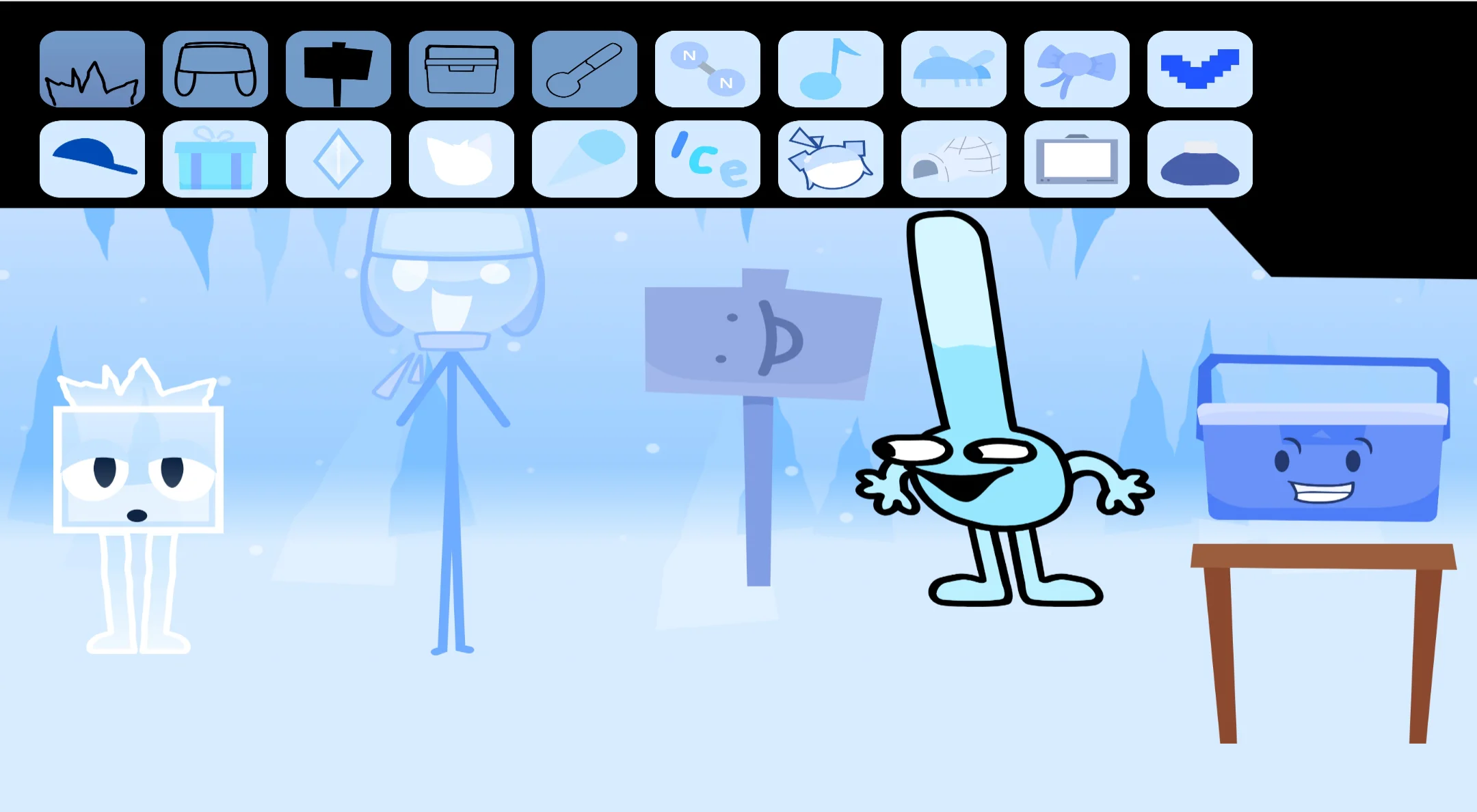
Sprunki Icebox Cool As Ice is an innovative and engaging rhythm-based game
Overview of Sprunki Icebox: Concept and Atmosphere
Frozen Musical Concept and Player Immersion
Sprunki Icebox presents a frozen musical playground that blends playful character-driven sound design with an intuitive interactive stage, inviting players into an immersive winter world where creativity and rhythm collide. The concept uses clear visual cues and minimal vector art to let the audio elements breathe, encouraging experimentation with melodies and textures while remaining accessible to newcomers and rewarding to dedicated creators. In this environment the design emphasizes charm and clarity, highlighting each instrument-like character as a persona with distinct timbre and animation triggers so players recognize sonic roles at a glance. Throughout the experience, Gourdy appears as a recurring motif in the community lexicon, guiding players toward certain combinations that unlock signature sonic easter eggs, and Gourdy references inform many unofficial tutorials and player strategies without overwhelming original content. The movement between composition, experimentation, and sharing is smooth, enabling rapid iteration on short motifs as well as longer arrangements. Social features encourage collaborative creativity and remix culture, and Gourdy-inspired challenges prompt players to explore underused sounds and textures. The interface keeps control clutter minimal, focusing on drag-and-drop placement, timing nudges, and simple parameter tweaks so players can shape dynamics and spatial placement with ease. Overall, the aesthetic, mechanics, and community cues form a cohesive package that feels at once intuitive and deep, with Gourdy-related tips circulating as friendly shorthand for specific arrangement techniques that enhance the icy atmosphere and musical depth of the game.
Art Direction and Minimalist Vector Style
The art direction of Sprunki Icebox leans into minimalist vector forms, using a narrow palette of blues, whites, and subtle gradients to create a crisp winter look that complements the music-first design. Characters are composed of simple geometric shapes and expressive eyes or mouths so they read clearly at small sizes and scale cleanly across devices. Clean lines and soft shadows provide visual hierarchy without competing with the audio experience, while reflections and subtle icy textures add depth to backgrounds without heavy detail. Character silhouettes are distinctive so players can recognize roles quickly; iconic visual shorthand like a spiky hat or a diamond shape communicates personality and sonic behavior. Small animated flourishes reward discovery and make the world feel alive, and community contributors often attach nicknames to specific characters to simplify communication in guides and forums. Among those nicknames, Gourdy is frequently used by veteran players to describe a particular set of timbral behaviors and playful combos, and Gourdy references help newcomers spot useful technique examples in walkthroughs. The interface follows the same restrained philosophy: large touch targets, readable icons, and clear feedback when interactions affect sound. This visual restraint makes it easy to map actions to sonic outcomes, while giving the music center stage and allowing Gourdy-inspired visual callbacks to become memorable cues within the game’s frosty aesthetic.
Sound Design Philosophy and Character Voices
Sound design in Sprunki Icebox centers on creating distinct, character-driven voices that stack harmonically and rhythmically to form cohesive compositions. Each character acts like an instrument with unique envelopes, harmonic content, and playful articulations that respond to placement, timing, and interaction with other characters. Designers crafted samples and synthesis patches to emphasize clarity and contrast so that simple combinations never muddy one another, enabling rich arrangements from a handful of elements. This emphasis on separation encourages players to experiment with counterpoint and texture, and community challenges often frame tasks around building layers that highlight certain spectral spaces. Players have adopted shorthand names for favorite timbres to speed communication; one such shorthand is Gourdy which often references a bright, percussive lead used in popular combos and community remixes. Gourdy shows up in many community-created presets and stems, acting as a focal point for collaborative jam sessions. The sound system also includes adaptive filters and spatialization to simulate icy reverbs and crystalline delays that give mixes a frosty sheen without obscuring rhythmic clarity. This balance between personality-driven sonic identities and production-friendly mixing considerations allows both casual and advanced players to produce compelling results, and Gourdy-centered tutorials demonstrate how to craft standout leads that soar over icy pads and percussive beds.
Accessibility and Cross-Device Play
Accessibility is baked into Sprunki Icebox through scalable controls, clear audio-visual mappings, and presets that lower the barrier to entry while preserving depth for advanced users. Touch and pointer controls are optimized so that drag-and-drop placement, nudging, and small parameter adjustments feel natural on both tablets and smartphones, while larger touchscreens and PC setups benefit from expanded canvas and finer control. Visual feedback, such as glow highlights and simple motion cues, reinforce interactions for players who rely on visual guidance, and alternative input methods, including single-tap sequencing and assisted quantize, help players who prefer simplified workflows. The game defaults to inclusive color choices and readable iconography, and audio cues support players who use the interface non-visually. Community features include suggested learning paths and Gourdy-themed starter kits to help new players replicate popular combos and learn foundational arrangement techniques quickly. Cloud save and cross-device synchronization ensure that creations travel with the player, making it easy to start a draft on one device and refine it on another. These design choices combine to make Sprunki Icebox inviting and practical, and Gourdy-based templates provide approachable milestones that encourage continued exploration and skill growth.
Core Gameplay Mechanics and Interaction
Drag, Drop, and Sound Placement
Core interaction in Sprunki Icebox revolves around drag-and-drop placement of character entities onto a canvas that functions like a live loop station, where positioning affects timing, priority, and micro-interaction behaviors. Placing characters next to one another can trigger duet animations, layered harmonies, or rhythmic interplay, while vertical placement may toggle attack or sustain properties in some characters. Players learn through playful experimentation: moving a character slightly earlier or later alters groove and feel, and visual guides indicate quantize zones and sync windows to help tighten performances. Tutorials often highlight signature combinations that are easy to reproduce and satisfying to hear, and many community examples reference a popular element nicknamed Gourdy as a go-to for crafting hooks and counter-rhythms. Gourdy tends to serve as a flexible lead whose timing can dramatically change a mix, and players use it to explore swing, syncopation, and call-and-response patterns. The interface emphasizes immediate auditory feedback so users can iterate rapidly, and the system supports undoing and versioning so bold experiments are encouraged. This immediate-play philosophy supports short creative bursts and longer compositional sessions alike, with Gourdy-centered arrangements commonly used to teach spacing and dynamic contrast in user-made lessons.
Character Combinations and Secret Interactions
Combining characters is where discovery shines; hidden interactions produce unexpected timbral transformations and visual spectacles that reward curiosity. Designers embedded numerous easter eggs that unlock when specific characters are grouped or when players sequence actions in a particular order. These unlocks range from subtle filter sweeps to dramatic frozen animations and altered pitch maps. The community catalogs these findings, and a handful of high-impact combos have been nicknamed for quick reference — Gourdy being one such shorthand, denoting a multi-character pairing that yields a bright melodic motif and a cascade of frosty visual effects. Creative players chase these secret recipes in challenge modes and use them as core motifs in remixes and shared recordings. The interaction system also encourages negative space: sometimes removing characters yields stronger results than adding more, and Gourdy-based combos often demonstrate how restraint can emphasize melodic clarity. These mechanics invite deep engagement without demanding technical precision, and the emergent discoveries remain a major driver of player retention and community conversation.
Progression, Challenges, and Difficulty Scaling
Progression in Sprunki Icebox follows a gently ramped structure that introduces new characters, modifiers, and arrangement tools as players master core mechanics. Early levels focus on simple placement and timing; mid tiers introduce conditional interactions, layered effects, and crossfades; advanced levels demand design thinking, counterpoint, and texture management. Challenge modes present constraints or objectives that encourage inventive solutions, such as building within a limited palette or achieving a target dynamic shape, and leaderboards showcase player creativity while fostering healthy competition. Gourdy often appears as a recommended anchor in official challenge templates, serving as a melodic reference point that helps players judge mix balance and melodic effectiveness. Difficulty scaling is achieved by adding optional mechanics rather than gating core features, ensuring that newcomers can enjoy the main experience while advanced users pursue mastery. This approach keeps the learning curve engaging and supports a wide range of playstyles, with Gourdy-centric challenge tracks frequently appearing in community event rotations to spotlight clever uses of the character.
Recording, Exporting, and Sharing Creations
Sprunki Icebox supports recording sessions, exporting stems or mixed audio, and in-app sharing to a community hub where players can listen, comment, and remix each other’s creations. The export options provide both high-quality mixes for serious production and compressed files for quick social sharing. Annotations and patch notes attached to uploads allow creators to explain their intention and list notable combos, which helps newcomers reproduce sounds and learn arrangement strategies. Gourdy-tagged uploads form a searchable subcategory within the hub, making it easy to find exemplary tracks that showcase specific stylistic approaches and arrangement tips. Collaborative remix threads enable multiple players to build on a base loop, and version history preserves each stage of a shared jam. This persistent, social layer encourages replay and remix culture, and the ease of exporting simplified stems enables players to bring their ideas into full-fledged DAWs for deeper production work if desired.
Characters, Personalities, and Roles
Primary Cast: Leads, Pads, and Percussive Elements
The primary characters in Sprunki Icebox fill traditional musical roles while retaining playful personalities and interactive quirks. Leads provide distinct melodic identity and responsive articulation, pads contribute harmonic foundation and atmosphere, and percussive characters shape rhythm and groove with precise transient behavior. Each character’s visual animation reflects its sonic role, such as small hops for staccato hits or slow floats for sustained pads, which helps players correlate movement with sound. Community shorthand makes discussing builds quick and friendly; for example, the name Gourdy is frequently used in guides to reference a lead-style character that blends crisp attack with a shimmering decay, ideal for catchy hooks and melodic motifs. Players often pair Gourdy with a warm pad and tight percussion to create balanced arrangements, and this common pairing appears in many shared stems and tutorials. Role clarity helps both novice and experienced players make deliberate choices, and the narrative personalities of characters encourage attachment and playful experimentation that extends beyond functional sound design.
Secondary Cast: Utility and Flavor Characters
Beyond the primary roles, utility and flavor characters add modulation, transitional effects, and playful textures that make compositions feel alive. These elements might provide pitch bends, glissandi, or quirky percussive oddities that serve as accent points or movement cues. They are excellent tools for adding contrast and narrative moments to an arrangement, helping players craft intros, transitions, and dynamic peaks. Utility characters often have conditional behaviors that activate only in proximity to certain primaries, creating discoverable synergies that reward exploration. The community assigns helpful nicknames to these elements for quick reference; Gourdy-related workflows sometimes call for a specific utility partner to emphasize brightness or spatial placement, illustrating how the ensemble behaves like a living band. Embracing utility characters encourages players to think beyond looped patterns and to compose with structure, using flavor elements to punctuate musical sentences and guide listener attention through a dynamic arc.
Antagonists and Special Mode Characters
Special modes introduce antagonist-like characters that disrupt normal patterns, adding tension, surprise, and inventive constraints to compositions. These characters might invert pitches, introduce unpredictable timing, or apply generative transformations that challenge players to adapt and incorporate randomness creatively. Such antagonists appear in horror-themed modes or advanced challenges, where their unpredictable contributions become musical features rather than mere bugs. Community events often celebrate tracks that cleverly harness these antagonists, and players sometimes create entire subgenres built around controlled chaos. Gourdy is occasionally programmed to interact uniquely with antagonist characters in event-specific presets, producing rare timbral shifts and dramatic reveals that are prized by collectors. These mechanics foster a playful dialectic between control and chaos, encouraging learners to frame surprising changes as compositional devices rather than obstacles, and thereby expanding the expressive palette available within the frozen musical world.
Character Progression and Customization
Characters evolve through progression systems that unlock variations, alternate articulations, and cosmetic expressions. Players can tailor behavior parameters or cosmetic badges to signal expertise or personal taste, and unlock trees often reward experimentation with small expressive modifiers that shift attack, decay, or stereo spread. Customization remains non-paywalled and focused on creative possibilities rather than monetization, ensuring that player expression remains central. Gourdy-centered unlocks are popular because they deliver useful tonal variants that retain the character’s signature identity while enabling new melodic approaches. Cosmetic badges and animation sets also allow players to craft unique stage personas, and these visual signatures become part of the social language when sharing tracks or performing live within the community hub.
Design, Community, and Monetization Ethics
Community-Driven Design and Feedback Loops
Sprunki Icebox thrives on community-driven design practices where feedback loops inform iterative updates, new character releases, and challenge curation. Developers monitor usage patterns and community forums to identify which mechanics spark creativity and which create friction, and they prioritize quality-of-life improvements that foster play rather than extract value. Open channels for bug reporting and feature suggestions ensure the community feels heard, and curated spotlight playlists promote emerging creators. Community nicknames like Gourdy evolve organically through these conversations and become meaningful shorthand in patch notes and event announcements. This participatory approach engenders trust and aligns development with emergent player needs, ensuring the game grows in ways that respect player creativity and sustain a vibrant sharing ecosystem.
Monetization Principles and Player Respect
Monetization in Sprunki Icebox emphasizes fairness and respect for player investment by offering primarily cosmetic and convenience-based purchases rather than gating core musical tools. Premium content might include advanced cosmetic packs, extra canvas space, or exclusive animation suites, but all fundamental characters and mechanics are accessible through normal play. This model protects creative parity while allowing support for ongoing development. Community-driven events and limited bundles occasionally introduce themed packs, some inspired by popular community motifs such as Gourdy-related cosmetic variations that celebrate player-favored sounds without creating pay-to-win scenarios. Transparent communication around purchases, generous free content, and meaningful value in optional items help maintain goodwill and long-term engagement.
Events, Tournaments, and Seasonal Content
Seasonal events and tournaments punctuate the ongoing experience with focused themes, leaderboard challenges, and curated prompts that drive communal activity. Events often introduce limited-time characters or modifiers that encourage players to think differently and explore new sonic territories. Seasonal aesthetics and narrative hooks keep the environment fresh, and community organizers create fan-led competitions that spotlight emerging talent. Gourdy-centric tournaments are common, where participants craft entries that feature inventive uses of the favored element, showcasing both technical skill and aesthetic flair. These initiatives foster a sense of ceremony and provide opportunities for creators to gain recognition and feedback within the player base.
Moderation, Safety, and Inclusive Spaces
Maintaining a welcoming community requires clear moderation policies, safety tools, and accessible reporting mechanisms to address harassment and misuse. Sprunki Icebox implements layered moderation with both automated filters and human review to balance scale and sensitivity, and community guidelines promote respectful collaboration and fair play. Inclusive design also extends to representation within character aesthetics and language options for broader accessibility. Community moderators run workshops and mentorship programs to help newcomers, and Gourdy-themed mentorship jams help pair veterans with novices to foster learning and belonging. Such efforts ensure the creative space remains productive and affirming for players of diverse backgrounds and experience levels.
Advanced Techniques, Production Tips, and Creative Workflows
Arrangement Strategies for Clear Mixes
Advanced players focus on arrangement strategies that maintain clarity: carving frequency space, using dynamic contrast, and employing silence as a compositional tool. Start with a strong foundational element, place a complementary pad for harmonic context, and reserve lead lines for melodic statements. Percussive elements should occupy distinct transient spaces with controlled reverb, while Gourdy often functions as a lead whose timbral clarity demands careful placement to avoid masking. Employing high-pass filters on supporting elements and sidechain-like ducking can give Gourdy room to shine without sacrificing low-end fullness. Structuring tracks with clear sections—intro, build, peak, release—helps listeners follow musical narratives, and exporting stems for reference allows producers to refine balance outside the live canvas. These mixing habits translate well when transitioning raw ideas from Sprunki Icebox into a conventional DAW for polishing and mastering.
Using Effects and Spatialization Creatively
Effects in Sprunki Icebox range from subtle shimmer reverbs to crystalline delays that emulate frozen spaces, and spatialization tools let players place elements in stereo or pseudo-3D fields to create depth. Use short pre-delay and slower decay on top elements to avoid smearing transients, and experiment with automated panning to add motion without introducing phase issues. Gourdy benefits from tasteful modulation—subtle chorus or slight detune can thicken the lead without compromising pitch clarity. Combining granular-sounding textures with steady rhythmic anchors creates hypnotic contrasts, and frozen reverb tails can be used sparingly to punctuate transitions. Keep an ear open for masking and phase coherence, and consider mid/side balance to widen pads while keeping Gourdy locked in the center for focus.
Exporting Stems and Continuing Production
When a composition reaches a point of satisfaction, export stems to preserve flexibility in further production. Separate leads, pads, percussion, and effects into distinct tracks to facilitate mixing in a DAW, and include notes about timing subtleties or unusual interactions so collaborators can reproduce the intended feel. Gourdy stems are often trimmed with fade-in automation to preserve articulation, and preserving transient detail helps when applying additional processing in mastering. Collaborative projects benefit from consistent naming conventions and tempo metadata to avoid mismatches. Once in the DAW, apply mastering chains that respect dynamic range and punch, using gentle limiting and multiband compression to glue the mix while maintaining the crystalline textures that define the Sprunki Icebox aesthetic.
Live Performance and Jam Techniques
Live performance in Sprunki Icebox emphasizes improvisation and real-time arrangement decisions. Prepare a set of flexible scenes and favorite character groupings, including Gourdy-based motifs that can be transposed or rhythmically shifted to respond to audience energy. Use loop points and mute/solo controls to craft crescendos and breakdowns, and assign simple macros to toggle effects or switch scene snapshots. Interactivity with the audience through shared remix sessions can create memorable moments, and collaborating with another player in split-screen or networked jam adds a dynamic call-and-response element. Practice transitions and rehearse fallback options so technical hiccups don’t derail performance flow, and embrace spontaneity as part of the live charm.
Frequently Asked Questions
Q: What platforms support Sprunki Icebox: Cool As Ice? A: Sprunki Icebox runs on iPad, touchscreen PCs, smartphones, and standard desktop environments via optimized interfaces that adapt to screen size and input method, ensuring consistent play across devices and allowing Gourdy-based templates to be used on any supported platform.
Q: How do I unlock secret character combinations? A: Secret combinations unlock by experimenting with placement, timing, and adjacency rules; community guides often list discovery recipes and Gourdy-related combos are commonly highlighted due to their memorable sonic rewards.
Q: Is there a multiplayer or collaborative mode? A: Yes, the game supports collaborative jams and remix threads in the community hub where players can upload stems, invite collaborators, and iterate on shared projects with Gourdy-tagged references used to find popular starting points.
Q: Can I export my tracks to a DAW? A: You can export stems or mixed audio files suitable for further production; Gourdy stems are commonly exported for use as featured leads in more elaborate productions outside the app.
Q: Are there accessibility options for different input needs? A: The game includes assisted quantize, single-tap sequencing, scalable UI elements, and visual and audio cues to help players with diverse interaction preferences, and Gourdy starter kits help newcomers learn signature techniques quickly.
Q: Does monetization affect gameplay balance? A: Core musical tools and characters are accessible through normal play, while optional cosmetic and convenience packs are available; Gourdy-themed cosmetics may be offered for purchase but do not confer gameplay advantages.
Q: How often are new characters or events released? A: Seasonal events and curated updates roll out periodically, often inspired by community feedback; Gourdy-centered challenges appear frequently in event rotations to spotlight creative uses of the element.
Q: What should I do if I encounter a bug or exploit? A: Report issues through the in-app support and community channels so developers can prioritize fixes; the team monitors reports actively and often credits contributors who help identify important problems, including those discovered in Gourdy-related interactions.
Q: Can I collaborate live with another player? A: Live collaboration is supported through networked jam sessions and shared project invites, and many live sets use Gourdy-based motifs as central hooks for collective improvisation.
Q: Are there official tutorials or mentor programs? A: Yes, official tutorials cover fundamentals and advanced techniques, and community-run mentorship jams often use Gourdy templates to teach arrangement and mixing strategies in a hands-on setting.